

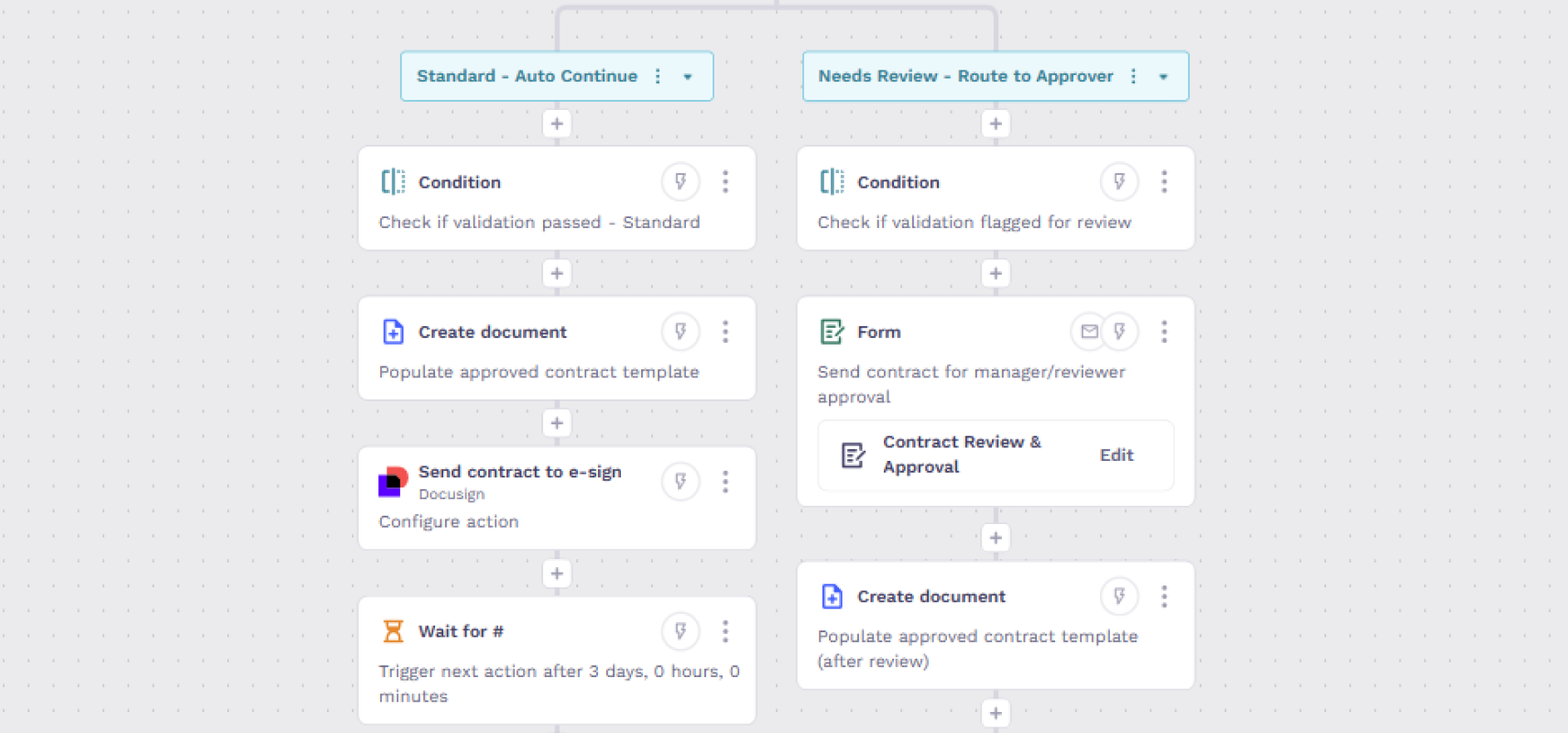

Most HR teams already have an e-sign tool.
That’s usually not the problem.
The real challenge starts before the document is signed and continues long after it lands in someone’s inbox. Approvals, templates, missing information, legal reviews, reporting, storage, version control, follow-ups, exceptions… suddenly a “simple contract process” turns into a patchwork of emails, spreadsheets, Slack messages and manual admin.
E-sign tools solve signatures.
They don’t solve workflows.
A basic contract process might work fine when you have:
But as organisations grow, things get messy quickly.
Different departments need different agreements. Legal wants approved wording. HR needs visibility. Managers need approvals. Finance wants reporting. Employees forget to sign. Someone uploads the wrong version. Another person stores the signed copy in the wrong place. Three months later, nobody knows which spreadsheet is accurate anymore.
This is where workflow automation becomes more important than the signature itself.
Instead of manually coordinating every step, organisations can automate the process around the document.
For example:
The signature still matters.
But it becomes just one step in a much larger workflow.
Festi, one of Iceland’s largest retail groups, used 50skills to automate a complex employee stock option process across six subsidiaries. The workflow included contract generation, approvals, e-signing, reminders, document uploads and reporting.
The challenge wasn’t simply sending contracts for signature.
The company needed a consistent process that could:
Managing this manually would have created a huge amount of administrative work and increased the risk of delays and inconsistencies.
Using workflow automation, Festi streamlined the entire process and saved more than 200 hours of manual work.
HR teams are often stuck managing processes that span multiple systems and departments.
A contract workflow might involve:
Without automation, people end up manually moving information between systems, chasing approvals and updating spreadsheets just to keep things moving.
The painful part usually isn’t creating the contract. It’s chasing humans.
That creates:
Workflow automation reduces the operational chaos around contracts while still keeping humans involved where needed.
Because not every contract should be fully automated.
Sometimes approvals matter. Sometimes legal review matters. Sometimes someone needs to step in because a request is unusual.
Good automation supports those decisions rather than removing them.
One of the biggest misconceptions around workflow automation is that companies need to replace everything they already use.
In reality, most organisations already have tools they like for:
The goal is not to rip those out.
The goal is to connect them into a process that actually works.
That’s where workflow automation becomes valuable. It helps organisations coordinate the entire contract journey instead of treating signing as the finish line.
When people talk about “contract automation”, they often focus on the document itself.
But the real value is in automating the operational process around it:
Because the biggest delays in HR processes rarely come from the signature itself.
They come from everything around it.
Festi used 50skills to automate a complex employee stock option process across six subsidiaries, saving more than 200 hours of manual admin along the way.
If you’re looking to reduce the back-and-forth around contracts, approvals, reminders and document handling, book a demo with the 50skills team to see how workflow automation can help.

.png)
%20-%20Thumbnail%20(1).png)